Monday, 18 July 2011

If it swims, serve a fino...

Wine and food matching, Jerez style. If it swims, serve Fino. If it flies, serve Amontillado. If it runs, serve Oloroso. 
 
What better place to taste sherry, in London at least, than Bar Pepito, the dinky sherry and tapas bar off-shoot of Camino? It's a small but perfectly formed homage to the bustling and cramped bars of Andalusia and provided an authentic place to taste Gonzalez Byass sherries and to test out that Andalusian food and wine matching advice.

We started with a taste of something that most wine drinkers don't get the chance to taste – mosto, or the base wine made from Palomino grapes that forms the departure point of fino, before it is fortified.

Dear reader, you're not missing anything. It did, though, afford me a Proustian flashback to Spain in the 1970s and a family holiday on the Costa Brava. Remember those super-sized oil and vinegar glass vessels (pictured left and called a porron) filled with something loosely called wine, which hapless tourists were expected to drink from? Same stuff.

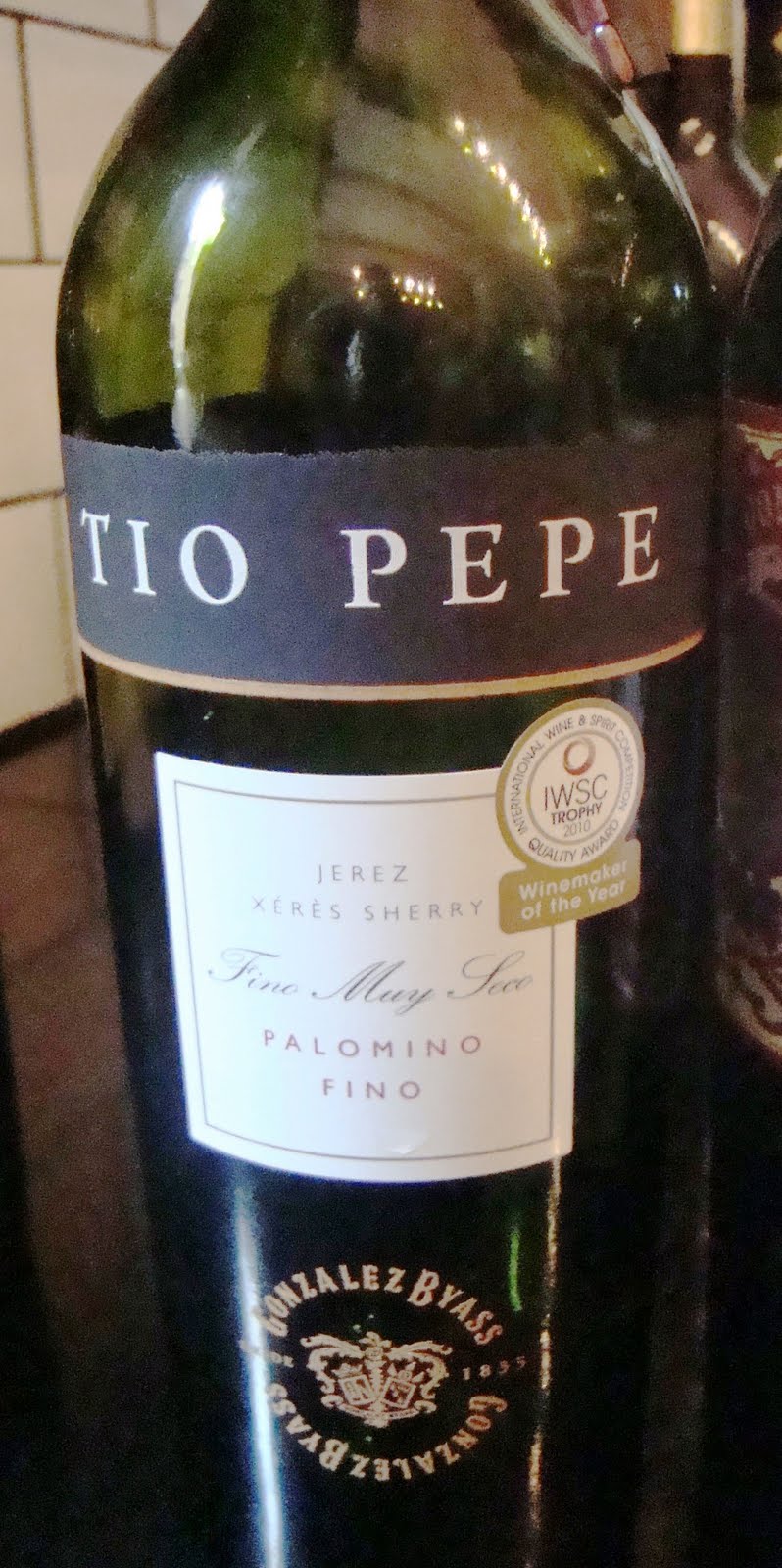
The fascination comes when you go on to taste Tio Pepe, the final product of this wine, once it has been fortified and aged in soleras under a protective layer of yeast (flor) for three years. The flabbiness and weight have gone and in their place are the crisp freshness and dryness which make fino the finest aperitif. There is also that unique mix of aromas and flavours which are hard to define (apple, almonds, rubber?) but easy to recognize.


Tio Pepe is a benchmark for fino, but our next taste was of his sexier, more flamboyant brother: Tio Pepe En Rama. En rama literally means twig and has the sense of raw, which in this case means that the wine is unfined and unfiltered. Essentially it's fino with the volume turned up, or nothing added, nothing taken away, Shredded Wheat style.

The colour is deeper and the flavours are more pronounced and it feels weightier, making this a great food wine. The only downside is that limited quantities are available each year, following a small bottling run in the spring. This year's stock is no longer commercially available, having been already snapped up, mostly by people in the wine trade.


Moving up a level of maturity, we tasted Viña AB Amontillado. Amontillados start their life in the same way as fino, maturing in barrel under a layer of flor. At Gonzalez Byass they then leave casks destined for Amontillado to their own devices. Over time evaporation means that the level of alcohol becomes too high for the yeast to flourish – eventually it dies off completely. Once the flor has gone, with it goes protection from oxygen and the wine undergoes oxidative ageing, giving it a darker colour and very different flavours.

Ten years old, still bone dry, and retaining some of the appley character of fino, but with flavours of caramel, golden syrup and nuts and a hugely long finish. Wonderfully balanced and a great companion to some jamon iberico (jabugo if you can stretch to it). It's still only 16% alcohol, which seems to contribute to the lovely poise and balance.

Del Duque 30 year old Amontillado is essentially the AB left to age in solera for a further 20 years. The wonderful aromas evoke Christmas: nuts, grilled almonds, dried fruits, beeswax and something floral. Length, poise and power.

The first thing anyone learns about sherry is that it is aged in solera, where small amounts of younger wines are continually added to the older barrels, resulting in a blending process which means that sherries are always based on an average age of the wines involved.

Now I discover that they set aside a number of butts each year which never get involved in the solera system, producing something I thought didn't exist: vintage sherry.

We were treated to a taste of Añada 1982: gorgeously fragrant, with nutty and mouthwatering complexity.

Apostoles 30 year old Palo Cortado and Matusalem 30 year old Oloroso Dulce are two old friends from my days at Oddbins. One of these would always be available for tasting in the run up to Christmas – and we had to taste along with the customers, rude not to.

Palo Cortado is a sherry style with myths surrounding it – that it started its life as a fino, but somehow veered off the usual path during ageing and transformed itself instead into an Oloroso.

The truth is, of course, more prosaic. Sherry producers know what they are doing and if they want to make a Palo Cortado, they will. Essentially it is the lightest style of Oloroso which often smells like Amontillado but tastes more like Oloroso.

The Apostoles has wonderful smoky, Tia Maria notes on the nose. The palate is sweet (sweet wine from PX grapes is added after ten years in cask) and it is apparently a great match for pheasant.

Sometimes sherry is so good, it's almost obscene. Just sniffing the Matusalem made me sigh inadvertently. Need I say more? Oh OK, sweet-sour combinations of bitter chocolate, savoury meatiness and a finish longer than January.

At the extreme end of sherry are the Pxs – intensely sweet, dark, sticky sherries made from the Pedro Ximenez grape. If you want to try one, don't muck about and head straight for Noë 30 year old Pedro Ximenez. It's like a crazy cocktail of soy sauce, treacle and the best, most expensive balsamic vinegar. It has a mind-boggling 400 grams of sugar per litre, so don't tell your dentist.


Recommended retail prices
Tio Pepe Fino - £9.99
Tio Pepe En Rama - £11.99 (not available until next year)
Viña AB Amontillado - £11.99
Gonzalez Byass Añada 1982 - £70 (not commercially available)
Apostoles - £16.49 (37.5 cl)
Matusalem - £16.49 (37.5 cl)
Noë - £16.49 (37.5 cl)


Thursday, 7 July 2011

Chocolates for summer?

Seasonal and local – if food can't manage at least one of these, they're just not cool. Chocolate is never going to manage the local bit, but what about seasonal? Still eating the same chocolates now that you were tucking into at Christmas? Well, yes, frankly, I am.


Over at La Maison du Chocolat though, they have released a summer collection of chocolates, Chiberta, with flavours hailing from the Basque country of southwestern France, designed to be eaten in the warmer months. 
 

The ingredients include things that we are used to finding in chocolates: honey, almond paste and praline. Plus there is the now obligatory chilli, or piment d'espelette – though here it has a definite flavour of the whole chilli pepper itself, rather than just the heat of chilli oil.


High quality chocolate, not overly sweet and intense flavours make for a classy product.

But don't even think of holding on to them until the winter...

More information: lamaisonduchocolat.com

Wednesday, 6 July 2011

Venice comes to Cobham

Carluccio's wine dinner, part of their Veneto food and wine festival

Being handed a glass of prosecco on arrival never puts you in a bad mood, so the evening started pretty well, with some Ruggeri Santo Stefano Prosecco.

The antipasti selection was a real step up from the standard menu at Carluccio's, with the usual suspects of olives and salami joined by a crispy and well-flavoured salt cod fishcake and a red rice salad – a nod to the sea-trading past of Venice.

With the antipasti we were offered a glass of Bertani Soave Sereole. I loved the dry minerality that dominated when drunk on its own. With the food, however, more sweet fruit emerged, enhanced by a juicy acidity.

The main course of spezzatino di manzo, a slow-cooked beef stew with some Venetian spicing, was the kind of homely-looking dish that you could happily dish up at home. But I would also love to see it on the menu here other than for this special dinner.

In the picture it may look like this was served with a side order of scrambled egg, but no, it is that con trick perpetuated on the UK restaurant-going public: wet polenta. Quite how restaurants continue to get away with serving up this tasteless pap – and charging money for it – is one of life's enduring mysteries.

The wine served with this course was a perfectly pleasant Sospiro Valpolicella Ripasso. Plenty of bright cherry-tinged fruit, softly structured but with noticeable acidity. Sarah, who kept me company on the evening, is not generally a red wine drinker, but decided she could drink this – despite what she termed the “dog end” finish (presumably in a good way). I would rather have had this wine with my antipasti and moved onto something more mellow and savoury with the long-cooked spezzatino.

Sadly, the pudding was not a highlight. Crema fritta sounds odd and indeed it is: a kind of lemon-flavoured Findus crispy pancake. We also suspected that more polenta was involved. The wine served with it, however, was a real treat.

Anselmi's I Capitelli is made by the passito method, where grapes are left to shrivel and concentrate before being pressed to make into wine. This gives extra depth, but still with deliciously light, tinned cling peach flavours. More than adequate as a pudding instead of the crema fritta.

Overall the food was tasty and well-prepared and the wines a good reflection of the region. If this is a sign of where Carluccio's is heading, great. I'd love to see some of these things on their menus all the time – just hold the crispy pancake.

Carluccio's festival of Veneto wine runs until 26th July. Wine dinners cost £35 per person and there are a series of tastings at £10 per person. More details at: www.carluccios.com.

Friday, 10 June 2011

Not wines for alfresco dining

Back in the heady days of May, when we were having a summer, I was sent some samples of wines for alfresco dining.  What a ridiculous idea that sounds now, when I sit nursing a cup of coffee to keep my fingers from freezing and realise the foolishness of wearing Birkenstocks when I know what I really need is a pair of woolly socks and some boots.

No-one wants to contemplate the delights of a chilled skinny white wine in such weather and you would justifiably think I had lost my mind if I recommended anything that might need chilling. 

Instead, grab yourself a bottle of Clos de los Siete 2008, £12.99 at Waitrose and Majestic.

This is a Matthew Pinsent of a wine.  Pretty supersized, but undoubtedly toned and muscular and never simply fat or out of proportion.  An Argentinian take on the classic Bordeaux blend, made by Mondovino pantomime baddy Michel Rolland, it's a blend of Malbec, Cabernet Sauvignon, Merlot (and some Syrah).  The fruit is plush and fragrant, but deep and dark and the tannins are pretty assertive, so I'd recommend this with something meaty.  Argentinians are famous connoisseurs of steak, so it's a fair bet that this would make a happy companion to sirloin or rump.  Or it would be a naughty luxury treat with a lamb chop.

Friday, 11 February 2011

Last minute wines for Valentine's Day

A shortlist of wines to accompany your celebration, from recommendations for the fiscally-challenged to the bank bonus flush, there is something for every romantically inclined wine drinker.

Saint Amour 2009, Domaine le Carjot - £10.99, Adnams
Saint Amour is one of the Beaujolais “crus”. Beaujolais, despite its many qualities, is not a favourite with UK wine drinkers – too many bubblegummy Beaujolais Nouveau perhaps. Saint Amour may languish on the shelves for 51 weeks of the year, but, courtesy of that name, this is its time – you'd have to be hard-hearted indeed to resist the name. Inside it's all lip-smacking, cool cranberry fruit that you can enjoy on its own, or sip alongside some salami.


If you want to make a statement, then nothing says “celebration” like fizz - and this is one occasion where pink is definitely called for.

Moscato Freisa Vino Spumante NV - £7.99, M&S - 2012 update, sadly out of stock at M&S.  Peter Lehman Princess Moscato is in the same fun, frothy and sweet vein and a 50cl bottle is £9.50 from slurp.co.uk

It's pink, it's sweet, it's fizzy, it's cheap. Something of a guilty pleasure, this will tick a lot of boxes for some and I for one am a sucker for this featherlight, grapey, sherbetty fizz, which would go down a treat with a fruity dessert.


If only the real thing will do, then Champagne it is. For reasons I still do not fully understand, you always pay a premium for the rosé version of Champagne. However, there are occasions where it isn't becoming to come over all Scrooge-like and this is one, so hang the expense and splash out a little.

Champagne Oudinot Rosé NV - £28, M&S
Around this price point there are some rather unpleasant pink Champagnes, but this got my vote for its delicate pale salmon colour and elegant, redcurrant fruit.

Bollinger Grande Année Rosé 2002 – £85,Majestic Fine Wine
If only the best will do, then I would have to recommend this, the best pink Champagne I've tasted. It's definitely a pale salmon rather than pink and invites you in with lively strawberry fruit and hints of rose petals. But as you savour this delightful drink you begin to appreciate the depth of flavour, courtesy of the pinot noir grapes that dominate the blend. It has a certain “grip” which makes it a great food wine as well as one to sip on its own – so no need to serve anything else when you eat. And frankly, how could you possibly top this?

Wednesday, 2 February 2011

Jacob's Creek at 28-50

I wouldn't have chosen the name myself. Because, confusingly, 28-50 is located at 140 Fetter Lane – but who am I to give them business advice when, clearly, the place is doing just fine, thanks very much.

28-50, the latest venture of Xavier Rousset, of Texture fame, calls itself “Wine Workshop and Kitchen”. To the uninitiated this might suggest a bit too much hands-on involvement from the customers, as though you are supposed to concoct your own wine and get stuck in to food preparation before sitting down. But fear not, ye lazy gourmands, there is nothing more strenuous involved than negotiating the stairs down from street level.

Essentially this is a restaurant, with a focus on interesting wines, many by the glass, which you can pair with a simple plate of charcuterie, or with a regular restaurant menu. Anyone who has set foot in Terroirs, aka the wine trade canteen on William IV Street, will be familiar with the set-up – and this place looks set to be just as popular with the wine cognoscenti, if the Twitter buzz about the place is to be believed. Our starter of dorade with puy lentils in a lemongrass velouté and main course of onglet with fat chips were good examples of unfussy, restaurant-hearty fare.

I was there to taste through the newly-launched Regional Reserve range from Jacob's Creek. Jacob's Creek Semillon-Chardonnay and Shiraz-Cabernet were some of the first New World wines that I ever tasted – and I'm sure I'm not alone, as they continue to be one of the strongest global brands to come out of Australia.

However, like many an early infatuation, I moved on to pastures new and now rarely find myself reaching for a bottle of Jacob's Creek as I trawl the wine shelves. So it was high time I spent an evening in its familiar presence – even if it was only for old times' sake.

Bernard Hickin, recently promoted to head winemaker, but part of the operation at Jacob's Creek for the past 30 years, laid out his stall right from the word go, with a delicious glass of Steingarten Riesling 2005. The fruit for this wine is mostly from the famous Steingarten vineyard in the Barossa, planted in 1962 and is still incredibly fresh, with great lemon 'n' lime acidity and a deep vein of minerality.


My favourites from the Regional Reserve range were the Riesling 2010, which comes from the Eden Valley zone of the Barossa. The wine is still not a year old and has a youthful lime blossom and citrus aroma. Those of you who fear Riesling = sweet, calm down dear, this is bone dry and finishes with a lemon sherbet freshness. It bemuses me that UK wine drinkers can't learn to love Riesling, when it shares many of the same characters with our current white fave, Sauvignon Blanc: bright, almost pungent fruit and racy acidity. But Riesling ages so much better and is infinitely more interesting as a variety.....have I convinced you?


The best red, for me, was the Shiraz 2007, also from the Barossa. Barossa and Shiraz go together like bottle and screwcap and this is a great example of a wine that tastes of where it's from, but is also extremely easy to like. It has aromas of a deeply fruity cake, the palate is fleshy, with soft tannins. But it is not a simple fruit bomb and it has good balance and great freshness too.

The Regional Reserves range also includes, from Adelaide Hills, Sauvignon Blanc, Chardonnay and Pinot Noir, as well as Coonawarra Cabernet Sauvignon. All retail for £9.99 at tesco.com and Tesco Wine Club. Sainsbury's stock the Chardonnay and Pinot Noir for the same price.

No matter how big a wine company they work for, all the winemakers I've met can't resist the opportunity to get their hands on high quality fruit and lavish attention on it in order to show off their skills – and things are no different at Jacob's Creek.

St Hugo is made from a selection of 30+ year old vines in Coonawarra and the 2004 vintage has just started developing some maturing coal tar and capsicum flavours in addition to the vibrant, leafy cassis fruit. It's a cabernet, so there are tannins, but they're fine-grained and just add a welcome texture.

Johann is a 60/40 blend of Shiraz and Cabernet and shows why these two varieties complement each other so well. The 2005 vintage will be winging its way to the UK this year, but I'd recommend tracking down a bottle of the 2001, which is drinking beautifully now, having developed those chestnutty, truffley and earthy flavours that take over once the initial, almost too-bright, fruit has begun to fade.


28-50, 140 Fetter Lane, London EC4A 1BT, http://www.2850.co.uk/
Jacob's Creek Regional Reserve wines are available at www.tesco.com and Sainsbury's
St Hugo 2006 RRP: £26.20 from Waitrose and Sainsbury's
Johann 2001 RRP: £36.65 from specialst independents

Tuesday, 7 September 2010

Walk with wine this Saturday

...or how to Indulge your passion and feel smugly righteous at the same time!
 
SATURDAY 11th SEPTEMBER 10.30
Our first "walks with Wine" event will be this Saturday 11th September - meeting at 10.30 am at The Parrot pub, Broadford Road, Shalford, Near Guildford, GU4 8DW. (Tel: 01483 561400).
 
The walk will be approximately 2 hours and around 7 to 8 kilometres, it will be at a comfortable pace to suit most people and levels of fitness -something more than a stroll but certainly not a power walk. On this particular walk there will be gentle hills, but nothing too strenuous. Please wear comfortable walking shoes/trainers and bring water in case it is hot.

When we return to the pub we will be conducting a fun informative wine tasting followed by lunch.

Our charge for the event is £20 payable upon arrival by cheque or cash to Red White & Rosé which is for the conducted walk, wine tasting and pub lunch.

We hope this appeals to you and we would love to hear from you to discuss further and/or confirmation of numbers as places are strictly limited. PLEASE DO PHONE TO BOOK - 01483 892678